ehemmerle@ehemmerle.com

ehemmerle@ehemmerle.com
2024/11/24
Link: Recap of the American Chamber of Commerce Shanghai
By Emmanuel Hemmerlé, 24 Nov 2024
The American Chamber of Commerce in Shanghai recently hosted its Annual Consumer Conference, an event dedicated to exploring how businesses can navigate China’s evolving consumer market landscape.
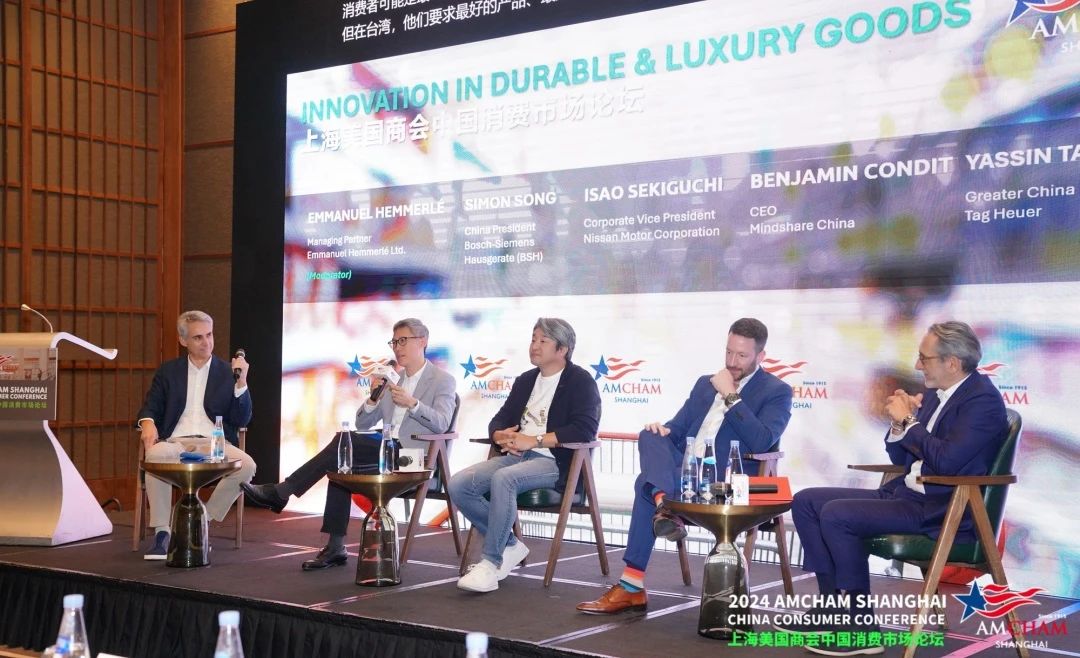
I had the honor of helping to organize and moderate a dynamic panel on how to win in China’s today market through innovation, featuring four distinguished leaders from diverse sectors:
Simon Song, Greater China President, Bosch-Siemens Hausgeräte (BSH)
Isao Sekiguchi, Corporate Vice President, Nissan Corporation, and Managing Director, Dongfeng Nissan Passenger Vehicle Company
Benjamin Condit, CEO, Mindshare China, GroupM
Yassin Tag, Greater China President, Tag Heuer, LVMH
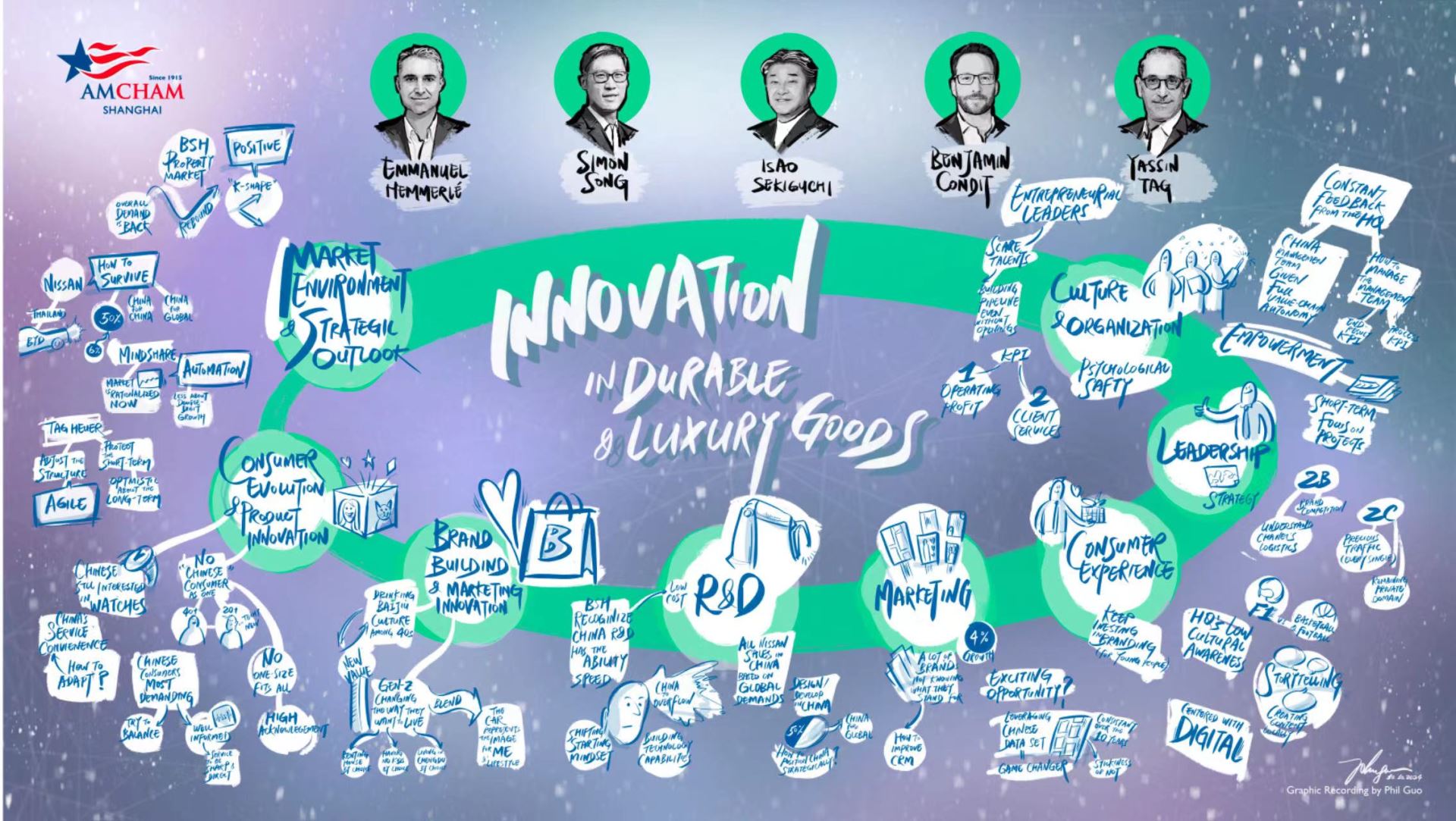
Here are my five key takeaways from the conversation that may benefit other leaders and entrepreneurs:
Economic Shift. With China’s economy now shifting to a phase of moderate yet high-quality growth, competition is intensifying. While consumption confidence is gradually returning — spurred by government policies — the rebound is uneven, creating opportunities and challenges across market segments.
Segment Shifts. In home appliances, for example, Simon Song of BoschSiemens described a K-shaped recovery: premium and lower-end markets are doing well, while the middle market continues to face significant pressures. “While the market can fluctuate quickly, there’s a cautious optimism for the future,” Song said. This new landscape presents new opportunities in areas such as the home renovation market. We just need to be aware that the growth driver has shifted — the demand is moving from decorating new homes to renovating existing homes. China’s vast base of properties will create great demands in renovation. Companies must be agile to catch the new segments.
Market Rationalization. There has been a slowdown, but China is still growing at close to 5%. If a typical mature Western market had such economic results, there would be fireworks to announce it! So it is necessary to relativize. As the market now has rationalized, we need to have a rational expectation of what China is going to be, Benjamin Condit of Mindshare noted. Mass consumer brands have challenges around profit margin. Consumers are still buying, but they're expecting lower prices. Companies in turn are required to do the same amount of work for less money.
Navigating Uncertainty. In the luxury industry, as Yassin Tag noted, predicting the next three to five years is difficult. “We can see more fluctuations going forward, and we need to adjust our structures to face the swing,” he said. “Be more fit. Be more agile. Being cautious in the short-term is protecting ourselves. But being optimistic about the long-term is also protecting ourselves, because we cannot dismiss the Chinese market in the next five to 10 years. China is for sure going to grow and we need to have a market share in China.”
Industry Reshuffle. Isao Sekiguchi of Nissan stressed that in the auto industry, the Chinese market is very competitive and has become extremely challenging for the legacy brands that have not been early movers into EV. They now must quickly retake market share through product and marketing innovations.
Not One Consumer! The concept of a “typical Chinese consumer” no longer exists. There’s no longer a single “Chinese consumer,” as Sekiguchi underlined, with which all panelists concurred. Consumers are becoming more diverse, demanding, and informed. Preferences vary widely across provinces, cities, and even lifestyles.
The Increasingly Seasoned Consumer. Chinese consumers are becoming more knowledgeable, increasingly looking for better quality at a reasonable price. However, there’s still a strong desire for the social recognition and quality associated with global brands. The new generation of consumers also expect clear, truthful communication from companies, making platforms like Xiaohongshu and Douyin essential in marketing strategies because Chinese consumers look there for education before they shop. Consumers today are well-informed and seek transparency, as all the panelists emphasized. Song pointed out that this makes it very difficult for brands to put out average products, because consumers have done their homework and won't be satisfied with second-tier quality. In this increasingly sophisticated, complex, and crowded social media environment, there is also a bigger challenge for brands to clearly communicate their products’ superiorities in a sharp and direct way.
Redefining Values. The younger generation in China has started to change the way that they want to live. Of course, many young people still value marks of “mainstream success” — you get a top-notch job in a tier-one city, buy an apartment, move out from your parents’ home, get married, raise a family, and drive a sedan or an SUV. But the younger generation starts to have different values. “Why should we take up a heavy loan to buy an apartment? We could just rent. Getting married is OK, but we can also decide not to have kids so we can enjoy life. We can move to tier-two cities to live a more comfortable life – such as Chengdu, a nice city to live, enjoy life and work balance. Why should I work 20 hours a day?” We need to capture these changes. This also requires us to consider the ways that we promote consumer products. For a car manufacturer, that may mean not only highlighting a model’s “wow” factor but also showing how it fits with the lifestyle the consumer desires.
New Aspirations. Sekiguchi noted that younger generations are redefining success, prioritizing flexibility and experiences over traditional milestones like homeownership. Younger Chinese consumers are redefining traditional aspirations, moving away from values like homeownership or marriage. Instead, they focus on comfort, individualism, and flexibility. This is evident in Chinese cities where consumers are increasingly drawn to more adaptable lifestyles, which calls for products that reflect these values — whether in design, pricing, or the overall experience they offer. Companies need to reflect the flexibility and individuality of the younger generation in their product offerings, particularly for second-tier city markets. "Comfort and personal expression now matter more than traditional milestones like owning a home,” he said.
Global Expectations. What has to change is our ability to serve Chinese consumers globally with the level of convenience that they have been spoiled with domestically. We need to have a global view of them, because the portion of their spending outside of China this year has surpassed that of 2019.
Demanding Standards. Chinese consumers are probably becoming the most demanding in the world, as Song emphasized. They want the best product with the best design and specs, but at the cheapest prices. As a manufacturer, on one hand, you need to squeeze in as many functions as possible to meet their expectations. On the other hand, you have to control prices to remain competitive. This really has put a lot of pressure on all the multinational companies.
Comprehensive Innovation. Companies must embrace innovation beyond just products, focusing also on marketing strategies, sales approaches, organizational structure, and leadership. To remain competitive today, it is imperative that companies rethink how they market, sell, and lead.
Global Innovation Shift. Leveraging China’s advanced R&D capabilities offers a powerful opportunity to accelerate time-to-market and create globally competitive innovations, as Sekiguchi-san highlighted.
China has rapidly become a leader in global product development, with local R&D capabilities now on par with, and in some cases surpassing, those of many Western counterparts. This advantage allows companies to innovate at a faster pace, delivering products more efficiently. What’s more, this local innovation is no longer limited to serving the domestic market—it provides a platform for creating products that can succeed internationally.
By tapping into China’s R&D capabilities, companies can simultaneously design products for both local and global markets, resulting in faster time-tomarket and cost efficiency. As Sekiguchi-san aptly stated, “Innovation no longer only comes from the West. China’s R&D capacity is rising fast and reshaping the industry.” Looking ahead, China is poised to become the leading global technology hub.
A concrete example of this shift is Nissan’s strategy. Starting in the second half of 2025, Nissan will begin exporting cars designed, developed, and manufactured in China to the global market. This move will cut the time to market for new models by roughly half compared to their previous timelines.
This marks the start of Nissan's transformation. However, this strategic shift prompts a broader question: “How should we position ourselves in the Chinese market? Sooner or later, we will be competing with Chinese auto brands in every market except Japan and the US. How will we stand out?” This is why it is essential to evaluate China’s role in our strategy — especially its R&D capabilities and its growing presence in the broader market.
Empowering China’s R&D. To fully harness China’s R&D capabilities, a fundamental shift in mindset is essential. Global headquarters must recognize that Chinese R&D teams possess the talent, expertise, and agility to develop products that not only rival but often surpass those created by HQ teams. Traditionally, global HQs have treated China as an “extended bench,” outsourcing tasks to simply reduce costs. However, forward-thinking companies increasingly realize that these teams provide far greater potential than just cost efficiency. Given the technological sophistication of the Chinese market, multinational companies should fully leverage the unique strengths of their Chinese R&D teams, particularly in cutting-edge areas like AI. Establishing global research centers in China and empowering them to take on a leadership role is essential. Eventually, the new products, features or functions developed in MNC’s China R&D centers will be embedded into new products for other markets.
Branding Essentials. As a prerequisite to innovation, a strong branding foundation is indispensable. Companies must return to the essence of their brand — clearly defining its purpose and values. This serves as the foundation for creating meaningful, resonant connections with consumers, which is not always the case these days with foreign brands in China.
For the past three decades, the market had experienced continuous growth, which has led some brands to become complacent. Many managers were promoted too quickly, without solidifying a strong foundation for their brands.
As a result, these companies are now struggling under pressure. To recover, brands must return to their core values and identity. It's essential for them to think beyond just advertising and focus on the overall experience they deliver. We need to convince consumers that the brands truly live up to their values. Partnering with the right marketing services firm is crucial to crafting a meaningful and authentic brand positioning.
Trend Mastery. It’s also critical for companies to understand what longer-term trends are most relevant to their brand and their value, as Benjamin Condit of Mindshare emphasized: “We liken cultural trends to meteors, planets, and stars. Meteor trends come and go in two weeks. Planet trends will not go away, but they run on orbits and are seasonal. The star trends will continue for a long time. It's critical for you to understand which longer-term trends are most relevant to your brand and your value.” Also, you need to identify these trends quicker than competitors to own them. When KFC decided to dive into esports and video games 10 years ago, they knew there was a community and were going to own it. They invested in it consistently for 10 years and it became the core to everything KFC does now. You need investment to support your efforts, but it doesn't have to be a huge investment at the beginning — the key is to be consistent.
Authentic Connections. We have seen an increasing desire for local-made products or homegrown brands. But it's not like a multinational brand has to become a Chinese one to succeed. Chinese consumers are looking for more respect or acknowledgement of Chinese culture or of the country, but they still have the desire to own international brands. But they want that international brand to show that “I care,” “I respect you,” and “I acknowledge you.” This is probably the single biggest meta-trend that we see across all the categories. Authenticity and acknowledgment are now critical to building long-term loyalty.
Global Consistency. Some global brands risk becoming something different in China compared to their identity elsewhere, which can be problematic. Chinese consumers are highly aware of what’s happening globally through social media and can easily spot inconsistencies in a brand’s messaging or image. Therefore, it’s crucial for brands in China to stay true to their core identity, ensuring that their presence in China reflects the same values and image they project globally. Brands must be careful to remain consistent, both in China and abroad.
Experience-Driven Branding. Brand building in today’s China market is also very much driven through consumer experience, and companies must be obsessed with it. Chinese consumers are increasingly demanding, not only in terms of product quality and marketing but also in their overall experience. In China, we’re seeing some of the most sophisticated consumer experiences globally. As a result, in best practice organizations, consumer experience is now deeply integrated with CRM and digital activities.
Innovation kicks in when brands enhance their CRM systems to better meet the needs of Chinese consumers. These systems should go beyond tracking data to deliver personalized, efficient, and seamless experiences, using customer insights to drive meaningful interactions through tailored recommendations, faster service, and superior support.
The Motivating Challenge. Motivating a team, particularly during challenging times, requires leaders to focus on short-term wins while keeping an eye on the long-term vision. Maintaining a resilient leadership approach ensures the team remains engaged and motivated. Regular, transparent communication about company goals, and highlighting both progress and setbacks, helps keep momentum high. “Keeping morale high with short-term wins while staying focused on long-term growth keeps the team aligned,” Tag observed. Mindshare’s Condit added that aligning on KPIs is another way to empower and motivate teams to take calculated risks, to experiment, and to innovate with purpose.
Culture of Boldness. In a rapidly changing market, fostering a corporate culture of innovation and entrepreneurship is key to success. Leadership must encourage calculated risks. Encouraging entrepreneurial thinking within an organization is about aligning team goals with broader company objectives while fostering an environment that encourages risk-taking.
Empowering Innovation. In a rapidly evolving environment, fostering a corporate culture of innovation and entrepreneurship is key to success. Leadership must encourage entrepreneurial thinking throughout their organization to foster an environment that collaborates toward goals and invites smart risk-taking. In our times, to catch local opportunities, HQs need to give more autonomy to China, and they also need to have the right leaders on both sides, in China and at HQ.
Autonomy for Action. In China's ultra-competitive and fast-paced market, global HQs must grant greater autonomy to China in order to capitalize on local opportunities. At the same time, the China management team needs to provide constant feedback and updates to HQ, ensuring they are fully informed about what’s happening on the ground. This is especially important since many HQs may claim to understand the Chinese market, but often lack a true grasp of the local dynamics. For this approach to work effectively, it is essential to have the right leaders on both sides — those who can manage this relationship both in China and at HQ.
Enabling Agility. Successful organizations in China empower their employees to make decisions quickly, supporting them through a culture that balances financial performance with innovation and client satisfaction. Entrepreneurial thinking thrives in a culture where teams understand the link between creativity and financial outcomes.
Fostering Entrepreneurship. When teams have the autonomy to take risks, creativity flourishes. This entrepreneurial mindset can drive business innovation and success. Partnering with the right executive search firm also helps attract entrepreneurial leaders who can drive these initiatives forward!
The American Chamber of Commerce in Shanghai, known as the “Voice of American Business” in China, was founded in 1915. AmCham Shanghai was the third American Chamber established outside the United States, and now has 2,800 members from 1,000+ companies. As a non-profit, non-partisan business organization, AmCham Shanghai is committed to the principles of free trade, open markets, private enterprise and the unrestricted flow of information. The Chamber provides opportunities for networking, company exposure, information sharing and government advocacy, as well as a variety of other value-added services.
EH is an Asia-focused leadership consulting firm that combines deep expertise with a personalized approach to help organizations build leadership teams capable of thriving in a rapidly evolving global marketplace. We work with some of the world's most prestigious companies across industries including consumer products, luxury, beauty, technology, healthcare, and automotive. Our core services include executive search, organization design, executive coaching, leadership assessment, and business insights. With long-standing relationships and an in-depth understanding of the Asian market, we help clients navigate complex challenges, attract top talent, and optimize their organizational structure to drive business success.
Previous: None
Next: Should Multinationals Consider Asia...
COPYRIGHT © 2022 EMMANUEL HEMMERLE Ltd.