ehemmerle@ehemmerle.com

ehemmerle@ehemmerle.com
2025/02/20
By Emmanuel Hemmerlé, 20 February 2025
While the case for reviving Asia-level organizations is compelling, as laid out in my recent article here, the transition requires careful handling.
The pendulum has swung too far from a comprehensive APAC strategy toward fragmented structures. To strike the right balance, a tailored, case-by-case approach is needed, factoring in company size and market dynamics.
Over decades of working with multinational corporations of various sizes and in a range of different sectors, I have experienced dozens of successes—and failures—at standing up an Asia-level organization. And I’ve learned a thing or two about the right recipe for a favorable outcome.
Here’s a more detailed look at what it takes to make a successful Asia-level organization work:
Business Needs. The scope of an Asia-level organization should be tailored to meet specific business needs. Key considerations include company size, strategic priorities, and the level of Asia expertise at headquarters. Smaller brands particularly benefit from adopting an Asia-level structure, but not exclusively!
Regional Scope. The scope of an Asia-level organization can vary from focusing on Northeast Asia (encompassing Greater China, South Korea, and Japan) to a broader East Asia structure (including Southeast Asia), or even a full APAC framework that incorporates Australia, New Zealand, and India to maximize synergies. Including the Middle East in an Asia-level structure can also be a strategic choice, given its strengthening economic ties with East Asia and India, making its integration into regional strategies increasingly relevant. After all, the Middle East is, geographically, West Asia!
China. For very large operations in China, establishing an independent China leadership is often justified, although this arrangement remains open to debate. In the case of a China independent organization reporting directly to global HQ, the organization’s global leader directly supervising the China business must have deep, direct knowledge of the region. They must also commit to investing in a strong, personal relationship with colleagues in China and visit the market regularly.
Choosing the Ideal Regional HQ Location. The ideal Asia hub depends on multiple factors, including industry needs and strategic priorities. Some Western leaders based in Hong Kong and Singapore highlight these cities’ strategic neutrality as an advantage for managing operations across Asia. They also offer tax incentives that have long influenced multinationals’ decisions. However, companies are often best served by prioritizing a strong business ecosystem, proximity to key markets, and access to top talent.
Given this, it makes sense for industry dynamics to guide location choices. Consumer-focused companies benefit most from Shanghai’s economic significance and deep talent pool, while tech firms are often better served by Shenzhen or Beijing, due to their dynamic innovation ecosystems.
Industrial companies, meanwhile, should prioritize locations with robust infrastructure and proximity to key manufacturing or supply-chain hubs, with Shanghai often being a top choice. For healthcare companies, establishing headquarters in Beijing or Shanghai is typically advantageous, while logistics providers benefit from Singapore’s world-class connectivity. In the financial services sector, Hong Kong remains the natural choice, given its global prominence.
I know of a Western multinational in the infrastructure sector that recently shifted its focus to Southeast Asia and India, leading it to relocate its Asia regional HQ to Bangkok. In such cases, geographical priorities can also justify the choice of location.
That said, the caliber of a regional leader is also a key factor. If you have—or are hiring—an exceptional leader for a consumer business who is based in Hong Kong or Singapore and isn’t able or willing to relocate to Shanghai, why not keep them where they are? Strong leadership deserves flexibility, especially when the regional HQ operates with a lean team.
Rethinking Asia-level Organizational Design. To thrive, businesses in Asia must embrace speed, entrepreneurship, and innovation. This requires a decentralized organizational model with minimal overhead. An effective Asia-level organization should prioritize lean, agile operations, reducing bureaucratic hurdles that slow decision-making. A streamlined structure accelerates action, allowing an Asia-level organization to empower local autonomy and entrepreneurial growth rather than acting as a bottleneck. The traditional model of Asia-level headquarters—bloated, costly, and overstaffed—is outdated. This inefficiency has contributed for good reason, albeit not solely, to the elimination of many such structures. Furthermore, many multinational corporations in Asia falter to keep pace due to slow, rigid, and risk-averse processes, losing market share to faster, more adaptive competitors—many of them local.
A Nimble, Business-Driven Organizational Framework. In today’s landscape, Asia-level leadership should be limited to a sleek, ultra-light coordination model, focusing on critical front-end and strategic functions such as marketing, innovation, product, business development, and CRM—managed by a very small group of executives. Meanwhile, supporting functions and sales should be predominantly decentralized, deeply anchored at the market level to stay close to local client needs and enhance operational agility. Even at the local level, supporting functions ought to be streamlined to a bare minimum, ensuring a lean and efficient structure. In this new era, priority must be given to front-end business functions.
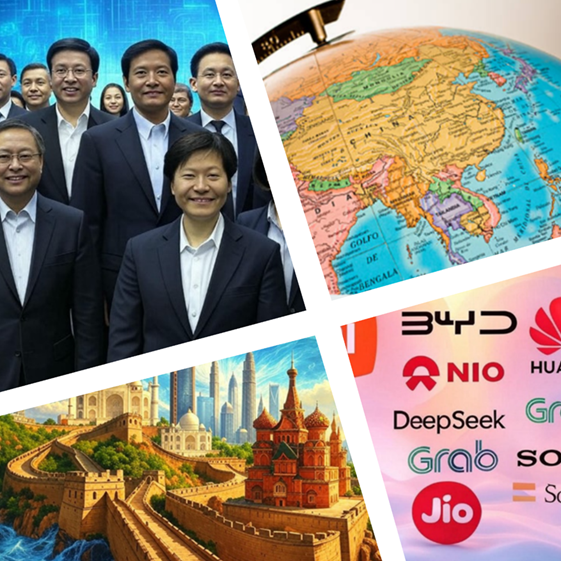
Effective Reporting. Clear and direct reporting lines, as exemplified by Asia’s winning companies such as Huawei, Xiaomi, BYD, Samsung, Reliance, Hitachi, and Sony, are crucial for optimal performance. Their blend of control and decentralization allows such hybrid structures to balance consistency, agility, and innovation. Thereby, both markets and functions should report directly to the Asia leader through straight reporting lines, while functional teams within markets should maintain only light dotted-line connections to global headquarters. Excessive dotted lines and matrixes, which hinder responsiveness and adaptability, should be avoided in the new context.
Flexibility. This decentralized approach, which champions flexibility and responsiveness, reflects the success of local Asian companies that excel by embracing simplicity, agility, and efficiency in their organizational structures.
Asia Experience. The success of an Asia-level organization hinges on appointing a proven leader with expertise across the region, that should include China for sure, and a deep grasp of the continent’s complexities. This leader must navigate market nuances effectively and capitalize on emerging opportunities. I am often asked by Western companies whether their Asia leader should be Asian (and, if so, from which country in Asia) or non-Asian or a Westerner. The answer is the same for an Asian multinational company’s European or American operations: Should the regional leader necessarily be a European or an American? In some cases they are, while in others they are not. And indeed, hundreds of organizational cases I have worked on in my career have taught me that leadership has no more nationality than it has a gender.
Leadership Qualities. The Asia leader must be entrepreneurial and a skilled communicator, both with global headquarters and local markets. They should champion market autonomy while also embracing delegation and empowerment. The leader must act as a mentor and coach to market and functional leaders, ensuring the organization remains agile and responsive. Decisive and action-oriented, they must drive functions and markets to move swiftly, take calculated risks, and challenge the status quo. As a relentless champion of innovation, they should foster a culture that encourages creativity and experimentation.
Key Talent Focus. It is important that the Asia leader directly owns the key talent agenda, personally driving critical hires in the region and ensuring the development and career advancement of key leaders within their team. This is an essential part of the role’s raison-d’être and success, and it cannot be ignored or delegated! A regional leader I know took ownership of the key hires agenda—something he previously didn’t consider part of his role. As a result, the business saw significant improvement. Many organizations could likely see a boost in performance if their leaders recognized the importance of personally driving the key talent agenda.
Integrity and Courage. Finally, beyond strategic and operational leadership, this leader must have a strong and independent personality. They must exemplify unwavering integrity and courage across markets, setting the standard through their actions and decisions. This must be a brave, direct-style, straight-shooter, action-driven personality—and generous. They cannot be a political animal who primarily cares about self-preservation and personal advancement. This would result in a total failure. For example, I know a regional leader who has the strength and courage to shield the region from the paralyzing political dynamics at HQ, creating an environment where entrepreneurial initiative and creativity can thrive in the Asian markets. Also, the regional leader’s fight in favor of ethical and transparent behavior within the whole organization in the region is an essential part of their duty to sustain the right culture and protect the company against the legal and reputational risks that could be disastrous for the company.
The widespread shift, adopted by Western corporations as a powerful trend over the last several years, from comprehensive Asia-level strategies to fragmented regional models, is no longer justified as a systematic one-size-fits-all organization. As Asia's dynamics have evolved, this approach has become an obstacle to growth in many cases, making a more discriminating, tailored strategy essential.
EH helps multinationals assess and refine their organizational models to align with global and regional objectives, offering tailored guidance to optimize Asia-level operations.
About EH
EH is an Asia-focused leadership consulting firm that combines deep expertise with a personalized approach to help organizations build high-performing leadership teams for a rapidly evolving global marketplace. We work with top companies across industries, including consumer products, luxury, beauty, technology, healthcare, and automotive. Our core services include executive search, organization design, executive coaching, leadership assessment, and business strategy. With long-standing relationships and deep market knowledge, we help clients navigate challenges, attract top talent, and optimize their organizational structure for success.
Discover more at www.ehemmerle.com

Previous: Should Multinationals Consider Asia...
Next: China’s Wake-Up Call for CEOs…in Time of US Tariffs!
COPYRIGHT © 2022 EMMANUEL HEMMERLE Ltd.